
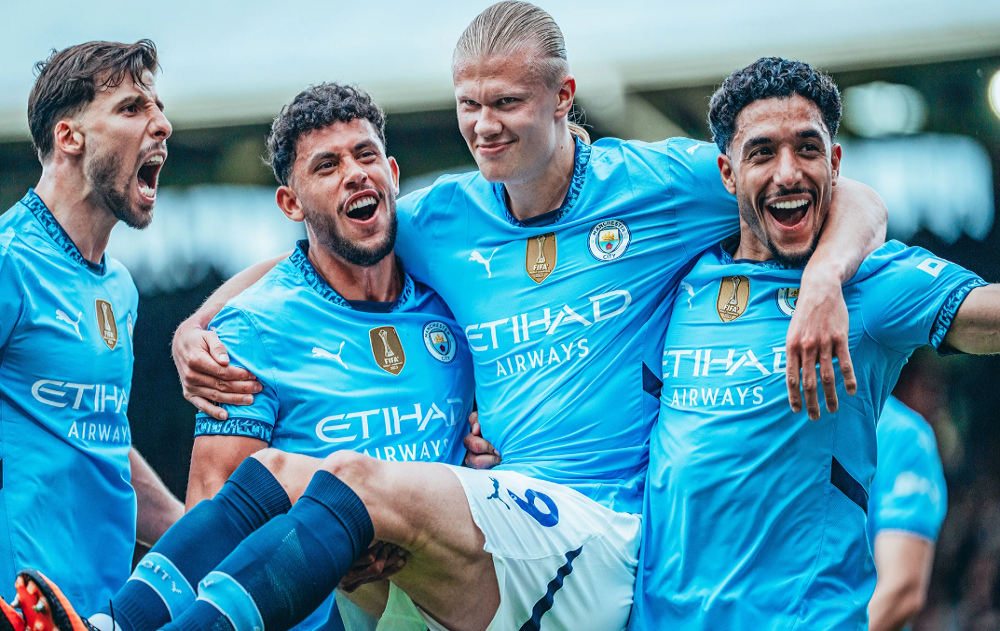
Modern football has produced dominant teams across every era — Ajax in the early 1970s, AC Milan in the late 1980s, Barcelona’s tiki-taka peak — but the sustained excellence that Manchester City has delivered under Pep Guardiola represents something the sport has rarely seen. A club that spent most of its history in English football’s middle tier has been transformed through investment, philosophy, and coaching genius into arguably the most complete footballing operation on the planet. The commercial indicators — including manchester city jersey sales that rank among European football’s highest — reflect a global fanbase built on genuine competitive excellence rather than historical prestige alone. Fans following City’s every match can find dedicated markets at dbbet argentina.
Manchester City FC: The Modern Football Machine
Manchester City FC under Pep Guardiola’s management has implemented a footballing philosophy so thoroughly across every aspect of the club’s operation that distinguishing between what the coach demands and what the institution produces has become genuinely difficult — which is itself the definition of complete organizational alignment. The playing style — high defensive lines, aggressive pressing, positional play that creates numerical advantages through movement rather than individual brilliance — requires players of specific technical profiles recruited with unusual precision against clearly articulated criteria. The club’s recruitment department, sports science infrastructure, and academy system have been rebuilt around the philosophical requirements that Guardiola’s system demands rather than around conventional football talent hierarchies that other clubs accept as givens.
Manchester City Standings: Consistency as the True Measure
Manchester City standings across domestic and European competition tell the story of a club that has made consistency its primary competitive characteristic — a more difficult achievement than individual trophy accumulation because it requires sustaining organizational quality across injury disruptions, fixture congestion, and the tactical adaptations that opponents continuously develop against a team they face knowing exactly what to expect. Premier League title accumulation under Guardiola has been extraordinary — multiple championships including an unprecedented four consecutive titles — but the deeper measure of City’s dominance is the points totals they have registered in seasons when the title ultimately went elsewhere. Finishing second with ninety-plus points would represent most clubs’ greatest ever season; for City it represents disappointment. That recalibration of competitive expectation is itself a form of dominance.
Real Madrid vs Manchester City: Football’s Modern Defining Rivalry
Real Madrid vs. Manchester City has emerged as Champions League football’s most compelling recurring knockout tie — two clubs whose philosophical, financial, and competitive profiles represent genuinely different models of elite European football colliding in matches whose quality has consistently justified the hyperbole that previews generate. Real Madrid’s ability to produce supernatural results in Champions League knockout ties — the comeback victories that statistical probability cannot explain but that the Bernabéu atmosphere and the specific psychological profile of Madrid’s squad somehow produce — creates a specific threat for City that tactical preparation cannot fully neutralize. City’s structural superiority — their ability to dominate possession, create chances at volume, and control game states through positional intelligence — makes them the team most capable of preventing Madrid’s supernatural moments from materializing. The tension between these competing tendencies produces matches that reduce football to its most essential competitive questions.
The Guardiola System: Understanding What City Does
Guardiola’s footballing philosophy at City has evolved through multiple iterations since his 2016 arrival — from the false nine experiment of early seasons through the inverted fullback concept that transformed City’s attacking width into central overloads through the high line defensive approach that maximizes pressing effectiveness while accepting the risks of space behind the defensive structure. What has remained constant is the commitment to collective movement — the idea that every player’s positioning at every moment is determined by the collective shape rather than individual instinct. This demands a specific cognitive engagement from players that not every technically gifted footballer can provide — several high-profile signings have failed at City not through lack of ability but through inability to internalize the spatial and movement demands that Guardiola’s system requires as baseline rather than aspiration.
Manchester City Jersey: The Commercial Phenomenon
The manchester city jersey market reflects a fanbase expansion that tracks almost exactly with the club’s competitive emergence as European football’s most sophisticated operation. Pre-Guardiola, City’s commercial reach was predominantly domestic — a large English fanbase but limited international profile. The Champions League title in 2023, combined with the Netflix documentary series that brought Guardiola’s methods to global audiences beyond the football-specific viewership, accelerated commercial growth in Asian and American markets that the club’s sustained excellence had been building across the previous decade. Kit design has become a specific commercial vehicle — the Oasis reunion kits that connected the club to Manchester’s music heritage generated media attention beyond football audiences entirely. Jersey sales figures that once lagged behind Liverpool and Manchester United’s global supporter bases have progressively closed the gap as the on-field product has consistently justified the commercial investment in following City.
Erling Haaland: The Weapon That Changed City’s Identity
Erling Haaland’s arrival at Manchester City created a fascinating tactical tension within Guardiola’s system — a striker whose natural playing style sits in philosophical tension with the false nine concept that City had refined without a specialist center forward, yet whose goal-scoring output is so extraordinary that accommodating his specific demands produced a more potent attacking system than the philosophically purer approach delivered. Haaland’s Premier League goal-scoring records — achieved in his debut season and subsequently sustained — reflect the specific advantage of placing the world’s most clinical finisher into a system that creates chances at higher volume than any other club in European football. The combination of City’s chance creation with Haaland’s conversion rate produces attacking output that opponents cannot defend against through conventional means — a problem that has no straightforward tactical solution because addressing one element of the threat exposes another.
The Premier League Title Race: City’s Domestic Dominance
Manchester City’s relationship with the Premier League title has been the competition’s defining narrative across the Guardiola era. The specific competitive texture of City’s title campaigns — the points totals, the sequences without defeats, the capacity to win ugly in weeks when their football does not reach the aesthetic heights that the system occasionally produces — reflects organizational maturity that distinguishes sustained champions from teams that win individual titles. The challengers who have most seriously threatened City’s dominance — Liverpool under Klopp, Arsenal’s current project — have done so by adopting aspects of the high-intensity pressing philosophy that Guardiola’s methods popularized, creating tactical conversations that confirm City’s influence on the broader competitive landscape even when individual title outcomes are competitive. The Premier League’s quality has been raised by City’s presence — other clubs spend more, develop more, and demand more from themselves because the competitive benchmark that City represents cannot be ignored.
The Treble and Its Historical Significance
Manchester City’s 2022-23 treble — Premier League title, FA Cup, and Champions League achieved within a single season — placed the club in football’s most exclusive historical category. Only a handful of clubs across European football’s entire history have achieved the domestic league, domestic cup, and continental championship simultaneously, and the physical and organizational demands the feat places on a squad make it genuinely exceptional rather than merely the expected output of a well-resourced club. The Champions League victory — ending City’s long wait for European football’s ultimate prize — completed the portfolio that defines a truly elite club rather than merely a domestically dominant one. Its significance for the club’s global commercial profile — the jersey sales surge that followed, the documentary interest, the fanbase growth in previously untapped markets — reflects how completely winning in Europe changes a club’s international standing regardless of domestic achievement.
What Sustains City’s Dominance Going Forward
Sustained dominance in football faces specific structural threats that financial resources and coaching excellence cannot fully neutralize. Squad aging — the inevitable decline of the players who built the current era’s success — requires continuous recruitment investment to replace quality without disrupting the collective understanding that Guardiola’s system demands. Guardiola’s own tenure at City cannot extend indefinitely — his eventual departure will test whether the footballing philosophy has been institutionalized deeply enough to survive the coaching transition, or whether it is primarily a personal expression of his methods that requires his presence to function. Regulatory scrutiny — the ongoing Premier League charges relating to financial rule compliance — represents an institutional threat whose resolution will either confirm or complicate the legitimacy of what City has built. The club’s ability to navigate all three variables simultaneously while maintaining competitive excellence is the defining organizational challenge of its next chapter.
