
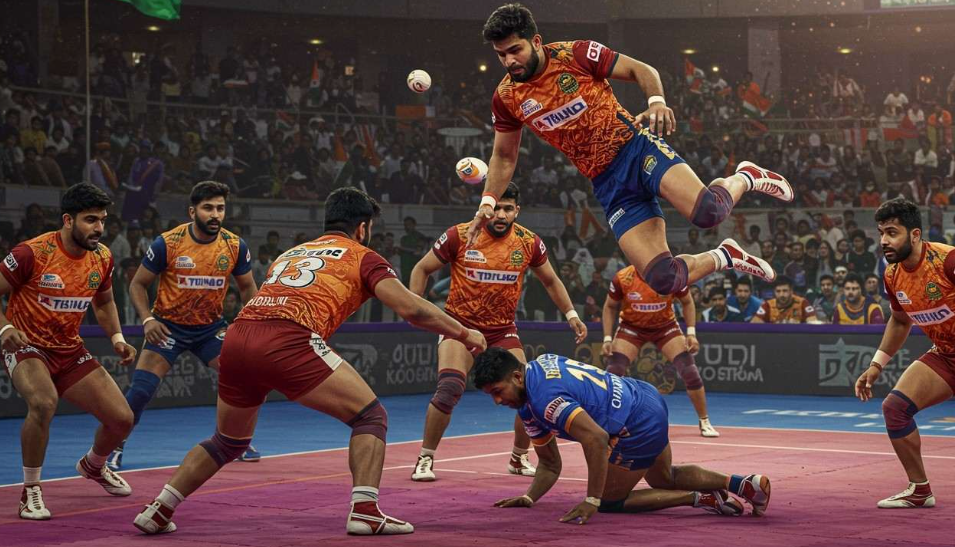
There are sports that require explanation before appreciation. And then there are sports that communicate their essence instantly — the moment you watch a kabaddi match unfold, something visceral and immediately comprehensible happens. One person against seven. A single breath. Pure aggression meeting collective defense. No equipment, no complex scoring technology, no specialized surfaces. Just human bodies, competitive intelligence, and the specific cultural electricity that India’s most authentically indigenous team sport generates wherever it’s played.
dbbet skachat follows indigenous sports development across South Asian markets with genuine analytical investment — recognizing that kabaddi match culture represents something genuinely irreplaceable within the indigenous sports of india conversation. This isn’t a sport that arrived from elsewhere and got adopted. Kabaddi grew from Indian soil, reflects Indian competitive values, and has survived millennia because communities across the subcontinent found something in it that no imported game has ever quite replaced.
What Happens in a Kabaddi Match
Understanding kabaddi requires understanding its fundamental dramatic structure — a structure so elegantly simple that children grasp it immediately while competitive depth rewards sophisticated analysis across entire careers of serious study.
The raider crosses the center line into opposition territory. They must tag as many defenders as possible before returning safely to their own half. The catch — they must do this on a single breath, chanting “kabaddi kabaddi kabaddi” continuously to prove they haven’t inhaled. Defenders must collectively stop the raider from returning. The raider must escape. Seven against one, repeatedly, across forty minutes of competition.
This structure creates tactical complexity that the simple description doesn’t immediately suggest. Raiders develop specific skill sets — ankle holds, kicks, diving techniques, and the specific body control that allows simultaneous attacking and defensive maneuvering against multiple opponents.
Ancient Roots, Modern Competition 🏛️
Kabaddi’s origins stretch into antiquity in ways that make precise dating genuinely difficult. References to kabaddi-like games appear in texts dating back over four thousand years — making this among humanity’s oldest recorded team sports. The Mahabharata contains passages describing combat games whose structural similarities to kabaddi are unmistakable to anyone familiar with both.
This ancient origin isn’t merely historical curiosity. It reflects how completely kabaddi is embedded in Indian cultural DNA — not as inherited tradition requiring conscious preservation effort but as living competitive practice that communities across India have maintained simply because they genuinely love it.
The sport’s development from village entertainment into organized competition with standardized rules, international federation governance, and professional leagues represents one of sport’s more interesting modernization stories — a genuinely ancient practice acquiring contemporary institutional infrastructure without losing the essential qualities that made it worth playing across four millennia.
Regional Variations: One Sport, Many Expressions
Kabaddi’s ancient spread across the subcontinent produced regional variations that reflect local cultural preferences and competitive traditions — different forms developing distinct rule sets, playing surfaces, and competitive emphases that practitioners identify as meaningfully different despite sharing the fundamental raider-defender structure.
Sanjeevani kabaddi — the form used in international and Pro Kabaddi League competition — revives players when opponents are eliminated, creating continuous team-size fluctuation that tactical decision-making must constantly incorporate. This form’s complexity makes it the most strategically sophisticated variation and explains its adoption as the competitive standard for organized modern kabaddi.
Gaminee kabaddi maintains fixed team sizes throughout matches — no revives, pure attrition, the losing team determined by which side completely eliminates the other. This form’s brutal simplicity creates intense strategic clarity — every successful tackle or raid carries irreversible consequence rather than the recoverable setbacks that Sanjeevani’s revival system allows.
Amar kabaddi’s continuous play format — players who are out moving to the end of the line rather than being eliminated — creates a different competitive rhythm that some regional communities have maintained alongside more internationally standardized forms.
South India All Sport Pack: Kabaddi in Regional Context
The south india all sport pack of competitive traditions reveals kabaddi operating within a dense ecosystem of indigenous sporting culture that makes southern India one of the world’s richest regions for traditional athletic practice.
Tamil Nadu’s kabaddi culture carries specific regional characteristics — playing styles developed within Tamil competitive traditions that differ subtly from northern Indian approaches in ways that practitioners identify immediately. State-level Tamil Nadu kabaddi competitions maintain remarkable community engagement — village tournaments attracting genuine crowd investment that professional sporting events in other disciplines struggle to generate in equivalent rural contexts.
Karnataka’s kabaddi tradition interweaves with the state’s broader wrestling and combat sports heritage — the specific physical qualities that wrestling culture develops translating powerfully into kabaddi’s physical confrontation demands. Karnataka’s kabaddi teams have consistently featured players whose wrestling-influenced physical development gives them specific tackling advantages.
Kerala’s relationship with kabaddi exists alongside the state’s dominant kalaripayattu heritage — the body awareness, flexibility, and movement efficiency that kalaripayattu training develops creating kabaddi players with distinctive physical vocabularies that coaches from other traditions find genuinely difficult to prepare for adequately.
Andhra Pradesh and Telangana’s kabaddi communities maintain particularly strong village-level competitive traditions — rural tournaments that continue operating independently of urban professional developments, preserving community sporting culture that modernization threatens in other regional contexts.
The Pro Kabaddi League Revolution 🌟
The Pro Kabaddi League’s 2014 launch transformed kabaddi from beloved cultural practice into genuine sports entertainment phenomenon — creating the commercial and institutional framework that professional athletes, corporate sponsors, and broadcast partners needed to invest seriously in what had previously been treated as recreational tradition rather than commercial sporting product.
Season one’s viewership figures surprised Indian sports media comprehensively — demonstrating that urban audiences who had never played kabaddi responded enthusiastically to professionally produced competition featuring elite players in structured franchise formats. The league’s television production quality, franchise team identities, and star player development created the commercial ecosystem that sustainable professional sports requires.
Player salaries transformed competitive incentives — creating genuine professional pathways for elite kabaddi players that previous generations couldn’t access regardless of competitive excellence. This professionalization attracted better athletes, raised training standards, and drove tactical innovation that traditional competition structures hadn’t generated at equivalent speed.
Tactical Evolution: Modern Kabaddi’s Complexity 🎯
Professional kabaddi’s tactical sophistication has evolved dramatically since Pro Kabaddi League’s commercial arrival — coaches and players developing strategic frameworks whose complexity rivals established team sports with far longer professional competitive histories.
Raiding has become highly specialized — different raider profiles developing specific skill sets optimized for particular defensive configurations. Bonus-line specialists whose physical profiles allow reliable bonus point collection in traffic create tactical options that defenders must specifically account for. Escape specialists whose ankle flexibility and body control allow them to break tackles that seem conclusively established have developed techniques that specifically exploit defensive momentum.
Defensive coordination has evolved simultaneously — cover systems that maintain defensive integrity when leading tacklers commit to stop attempts, super tackle strategies that convert defensive success into point advantages, and the specific trust between corner and cover defenders that allows coordinated blocking without communication opportunities.
Kabaddi’s International Spread 🌍
Kabaddi’s international development — driven by Indian diaspora communities carrying competitive traditions into adopted homelands and the Asian Games’ inclusion legitimizing the sport within continental institutional frameworks — has created genuine international competitive communities across South Asia, East Asia, and increasingly beyond.
Iran’s kabaddi program has developed genuine competitive excellence — regularly challenging India’s dominance in international competition through systematic development investment that reflects serious national sporting ambition rather than token participation in a South Asian cultural practice. Iranian kabaddi’s physical intensity and tactical sophistication have made encounters with Indian teams among international kabaddi’s most anticipated competitive fixtures.
Bangladesh and Pakistan maintain deep kabaddi cultures whose competitive traditions predate modern international organization — community-level kabaddi remaining central to sporting life in ways that urban modernization has affected less completely than other traditional sports. Their international competitive development reflects these authentic cultural foundations rather than manufactured programs pursuing medal opportunities without genuine community sporting roots.
Kabaddi’s Future
Kabaddi’s trajectory involves simultaneous development across multiple dimensions — continued professional league growth, expanding international competitive communities, sustained village-level practice, and the specific challenge of maintaining authentic cultural connection while embracing the commercial sophistication that global sporting visibility requires.
The sport’s Olympic inclusion aspiration represents the ultimate institutional validation question — whether kabaddi’s specific competitive qualities translate into the format and viewership experience that the International Olympic Committee requires for program inclusion. The arguments for inclusion are genuine: global participation across meaningful countries, established international federation governance, and competitive qualities that communicate immediately to audiences without prior knowledge.
What kabaddi ultimately doesn’t need is external validation to confirm its worth. Three thousand years of continuous community practice across the world’s most diverse cultural landscape represents the most convincing possible evidence that something genuinely valuable lives within a single breath, a crossed line, and the ancient competition between one person’s freedom and seven people’s determination to prevent it.
